Exploring Science Through Science Fiction
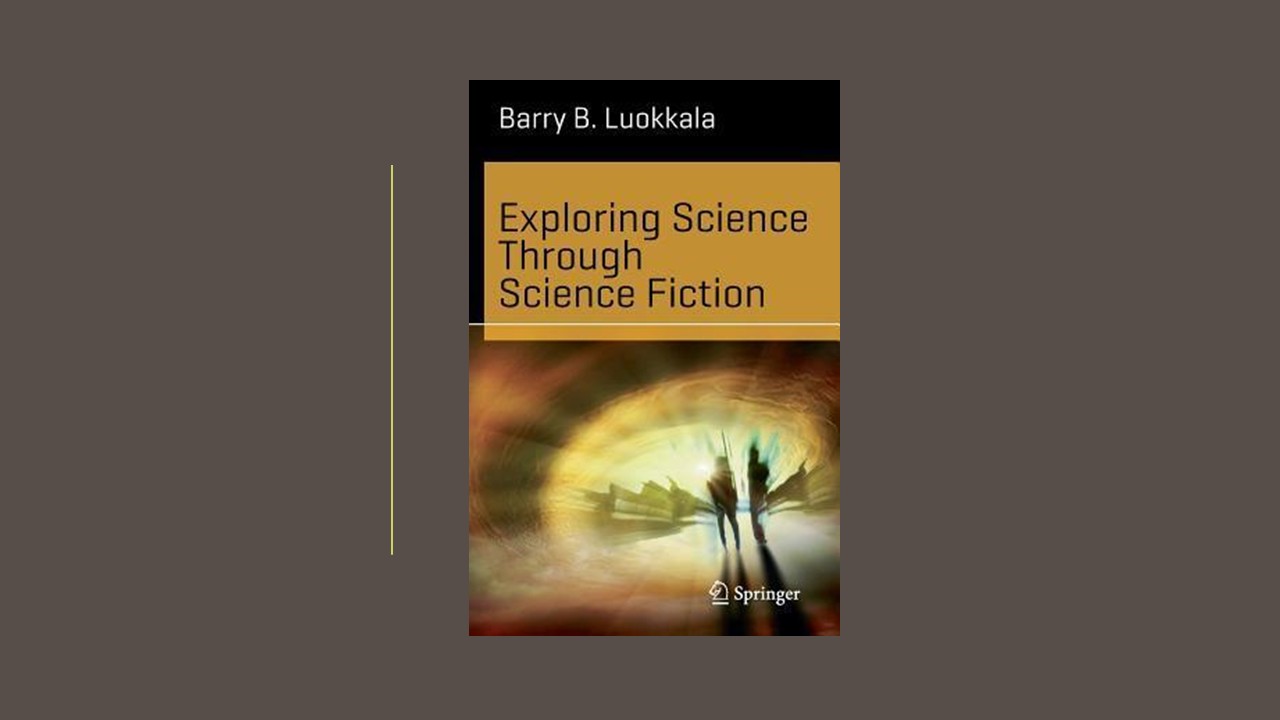
Exploring Science Through Science Fiction, Barry B. Luokkala. Springer (ISBN: 9783030293932) 2019 (review is from first edition, 2013).
Summary: A college text using science fiction to discuss basic science concepts and cutting-edge research.
Most of us can remember television programs and movies in the science fiction and related genres, wondering at times about the science behind the fiction. Everything from The Jetsons to The Matrix raised questions about space travel, time travel, robots, artificial intelligence, and bio-technical advances that enhanced or augmented human capabilities. Many of us remembered the communicators on the original Star Trek when the first flip phones came out. And now, we carry more computing power in our pockets than the Apollo space missions.
Barry B. Luokkala is a physics professor at Carnegie Mellon University. Inspired by Lawrence Krauss’s The Physics of Star Trek, he put together a course for both science and humanities students using film and video clips around five topics in science. Students would engage in critiquing the clips in light of current scientific knowledge. The courses were met with enthusiasm by both students in the sciences and those who were not. Then, in 2009, Springer approached Luokkala for textbook proposals and supported a proposal to create a text out of the course materials for this book. The first edition (the one reviewed here) was released in 2013, with an update in 2019.
After an introduction introducing the idea of the book, particularly distinguishing what is real, possible, and impossible. the book explores seven big questions;
- What Is the Nature of Space and Time? (The Physics of Space Travel and Time Travel)
- What Is the Universe Made of? (Matter, Energy, and Interactions)
- Can a Machine Become Self-Aware? (The Sciences of Computing and Cognition)
- Are We Alone in the Universe? (The Search for Extraterrestrial Intelligence)
- What Does It Mean to Be Human? (Biological Sciences, Biotechnology, and Other Considerations)
- How Can We Solve Our Problems? (Science, Technology, and Society)
- What Lies Ahead? (The Future of Our Technological Society)
Each chapter introduces basic scientific information related to the topic and then explores instances in science fiction and whether they are real, possible in theory, or impossible. One of the most interesting examples for me came in the chapter on the nature of space and time. General relativity predicts the possibility of gravitational waves, something The Excelsior experiences in Star Trek VI: The Undiscovered Country. When the first edition was written, the LIGO project had just launched but gravitational waves were still just theoretically possible. Then, in 2015, observers confirmed their existence and possible moved to real.
One of the fun things is that students get a chance to explore the plausibility of science fiction events. Mission to Mars, for example describes the puncture of the hull of the spaceship by micrometeroids, with alerts going off that they only had minutes to patch the leaks. Luokkala explores the science behind this and translates this into equations students can use to calculate how long the crew actually had.
In other instances, clips help set up discussions. For example, the episode of Star Trek: The Next Generation entitled “The Measure of a Man” involves a trial in which Lt. Commander Data faces the possibility of disassembly, which raises the question of the rights of machines, particularly if they are sentient, aware of and prizing their own existence.
In addition, each chapter concludes with suggested exploration topics with suggestions of relevant articles. For example, the chapter on what it means to be human includes exploration topics on genetically engineered influenza viruses, cell phone radiation, cancer vaccines, and human teleportation. Speaking of teleportation. Even if we developed the technology, Luokkala offers equations of the energy, data storage, and CPU time it would take to transport just one person. The answers are pretty staggering.
One of the most interesting chapters is on “how do we solve our problems.” After discussing perceptions of science and the reality of pseudoscience, students explore questions like world hunger, health care, and conserving resources. Likewise, “what lies ahead?” explores accurate predictions and visions of the future.
In all the book includes over 220 references to 160 works of science fiction in books, television, and film. An appendix list all these sources, and track information for relevant clips. There is also an appendix providing solutions for problem exercises in the text.
The one challenge of a book like this, illustrated by the discovery of gravitational waves, and the development of cancer vaccines is how quickly we move from possible to real. I also wonder how, in the light of rapid advances in robotics and AI, how the author would revise this chapter. Given that the most recent revision was in 2019, might be time for another one!
However, I found this a fascinating text, exploring the science itself as well as the larger ethical issues around it. It is useful to explore the nature of science as well as the implications of our technological applications. Even if the math parts are challenging, the discussions are relevant no matter in what field we work.
_____________
Disclosure of Material Connection: I received a complimentary copy of this book from the author for review.