Review: The Irresistible Community

Irresistable CommunityThe Irresistible Community, Bill Donahue. Grand Rapids, Baker Books, 2015.

Summary: Looking at the upper room narratives, Donahue explores how Jesus created community through the table, the towel, and the truth.

As I sat down to write this review, I found my fingers stumbling over the correct spelling of “irresistible”. Then I found myself stumbling over the concept. Was the community Jesus formed in the upper room truly irresistible? I don’t think Judas would have thought so. Frankly, I think this title is a bit of publishing hyperbole. What I do think Donahue has done is describe three marks of a community that changes lives under the leadership of Jesus, and this is in fact an important contribution to the life of our churches and other places where Christians gather and attempt to be “communities”.

The first of these marks is that they are communities that welcome all to Jesus’s table. This involves practicing good table manners from welcoming, to seeing and being the truth, to establishing trust, forgiving, and settling for progress rather than insisting on perfection. Donahue talks about different kinds of tables from the kitchen table to the coffee table to the conference table that each are appropriate at a certain stage of community life. Tables are places of stories, places where we take time to hear each others stories and consider how they come together in the story God is telling through this community.

Our encounters in truly welcoming each other at the table lead to the ministry of the towel, the challenging work of learning to truly serve each other in community. There is the issue of being clear about our identity as serving communities–do we embrace this and clearly understand how we are called to serve? True serving means our towels will get dirty as we jump in where we are needed. True serving means keeping our towels in a circle, remaining accountable to and responsible for each other. True serving means leaning into the sources of renewal when we are tempted to throw in the towel.

Finally, real community is galvanized by the truth. It is a community that hungers for truth and is open to the ministry of the Spirit of truth. It is a community where we tell ourselves the truth, where we lovingly and honestly reflect back to each other the truth we need to grasp about ourselves. It is a place where we challenge false narratives about God, ourselves and others. Truth can be dangerous, calling us into places of risk in the adventure of following Christ

Donahue uses an interesting device to open each chapter. He begins with an “interior narrative” of what each of the twelve disciples at the table are thinking as they sit around the table in the upper room. Each is paired to the content of the chapter.

Welcome. Service. Truth. I do think these are marks of healthy communities. But not all will accept our welcome. People will turn away from our service. And sometimes holding to the truth, however lovingly, will turn away those not ready to face the truth, particularly about themselves. So, while I find the community Donahue describes authentic, transforming, and real, I still don’t get the irresistible. But I think we can learn things from the community he describes that will benefit the communities of which we are part. That’s good enough.

_____________________________________

Disclosure of Material Connection: I received this book free from the publisher. I was not required to write a positive review. The opinions I have expressed are my own. I am disclosing this in accordance with the Federal Trade Commission’s 16 CFR, Part 255 : “Guides Concerning the Use of Endorsements and Testimonials in Advertising.”

Double Vision

IMG_2270Double vision. We usually do not consider this a good thing. A friend of ours suffering from MS could not drive for a period of time because of problems with double vision. Double vision resulting from crossed eyes (strabismus) in children is treated surgically as early as possible so the brain does not become accustomed to seeing double.

At the conclusion of our pastor’s message this week, our pastor spoke of the importance of a certain kind of double vision that not only appraises and celebrates where God has brought us thus far, but also looks to the future and the good that God might do among us. His message was a kind of “review” for our congregation that explored both where we are, and where, under God’s grace, we might go.

I was also struck that there is another kind of “double vision” that was evident to me in this message. It is the double vision that looks both at our congregation and our community. I was grateful for the reflection upon each and the model of “watchful brooding” over both, the kind of watchfulness shepherds exercise that watches both the flock and the surroundings, both for good pastures and possible threats. Here are some of my own responses to each:

Congregation (Who We Are): One important insight that Rich shared was our “highly-leveraged” character. For the most part, it is not a challenge to get us to “do more” and I am grateful that this is reflected in a recognition that we don’t need to add more things to our programming or congregational calendar. Most of us see our “ministry” as something that happens outside the church walls and our impact isn’t necessarily reflected in church growth so much as in the various workplaces, organizations, and informal networks we work in. There is a kind of hiddenness in this that seems attractive and is contrary to the ABC of “attendance, budget, and campus” that serves as the metric of success in American Christianity.

Two reflections in this regard: 1) It might be fun to “map” our involvements and explore the question, “if this is how God is gifting and calling each of us, how might he be calling ALL of us?” 2) It seems that what happens in our gatherings on Sundays, in Life groups and other gatherings in some way sustains and equips us for a good deal of ministry on the outside.  What was shared about having a “contextually appropriate strategy for deepening the spiritual transformation, the growth of discipleship” for our congregation really makes sense!

Community (Where We Are): I so appreciate the continued dreaming our pastor and so many are doing about serving the community that is northwest Columbus now. We have a Governance Team that really serves us well! One interesting insight for me, though, from the message, is that our building and property really is a key interface between our congregation and the wider community.

What is real for the community that encounters us is a place located at 7260 Smoky Row Road. It is a place where food is stored and distributed by caring people. It is a place where students, who traditional schools have been unable to help, have another alternative. It is a place where people grow fresh food while children play on our ark. It is a place where singers rehearse in our worship space, using our chairs and piano and lighting, while glimpsing the tangible signs of our life together as they come in and out. It is a place where people vote, and experience welcome as they do so.

So, while it doesn’t seem glamorous and seems “institutional” to pay attention to buildings, what struck me from what Rich shared is how many “flesh-and-blood” human beings interface with our congregation through the building and grounds at Smoky Row. As was noted, we’ve made lots of headway over the last years in improvements. But this realization also helps me see how urgent it is to pray for someone with the skills and passion needed to lead our stewardship of this place God has given us that is such a crucial interface with our community.

I’m moved by this message that as I pray for our church, I need to pray with “double vision” not only with regard to our past and future, but also with regard to praying both for our congregation, and for the community in the midst of which we gather and who we are called to serve. Our pastor gave us a great model of paying close attention both to what is going on inside our church and in our community. I hope I can imitate that as I pray for our life and mission.

These are the things that particularly encouraged and challenged me. How about you?

Going Deeper Questions: If you are from Smoky Row, what most encouraged you and what most challenged you from Rich’s message?

If you are someone else following the blog, what would it mean to have “double-vision” for your church and your community? What do you see as you look at each in your context?

This post also appears on our church’s Going Deeper blog.

Bringing Discipleship and Scholarship Together–Part Two

Yesterday, I wrote that because scholarly communities are formative communities, Christians and other persons of faith who care about a seamless connection between belief and scholarship need to engage in what James K. A. Smith calls “thick formative practices” that foster that seamless connection.  The alternatives to this are assimilation into the prevailing worldview and values of one’s scholarly community at the loss of vibrant Christian faith, the bifurcation of life into sacred and secular categories resulting in privatized faith and a public embrace of the worldview of one’s discipline. A third alternative is the “embattled enclave” mentality, where one holds to one’s faith convictions but engages with one’s discipline from an exclusively conflict-oriented posture.

Today, I want to turn to what those “thick formative practices” might be. I would like to focus on four practices which I believe important to bringing our discipleship and scholarship together.

1. Cultivating practices of attentiveness to God in one’s life. Years ago, as a college student, I was taught the habit of “The Daily Quiet Time”. At times this is maligned as inflexible, or confining of God to one’s personal devotional life. This needn’t be the case and there are a variety of spiritual practices of attentiveness one may explore in these private times with God over a lifetime.  At the core of all of these practices is the idea of listening attentiveness to God, in prayer, in scripture, and in the examination of one’s life resulting in a response to God of joyful worship, trust in the practical matters of our lives, and obedience to the commands and precepts and personal insights from God that we gain in these times. What I and others are discovering more in recent years is that the habit of humble attentiveness is one that spills over into academic life, as we seek to attend to the creation, to data, to other voices–listening for the promptings of God–sometimes in the form of questions that turn into research questions, sometimes in terms of insights.

life of the mind book

2. Learning to think Christianly about all of life. This practice flows from the practices of attentiveness as we consider, what is God’s pleasure in this area of research, this area of human activity, this personal endeavor, this relationship? But there are two additional pieces that the scholar-disciple needs to cultivate. One is a devotion to study of Christian sources: the Bible with the end of understanding God’s redemptive story as that is worked out from cover to cover, the basic contours of Christian belief captured in creeds, confessions, and theological works, and at least some understanding of Christian history and how believing people have confronted life’s greatest questions over two millenia. It is often helpful to ask how the truth we encounter bears on the questions of our disciplines. Mark Noll in Jesus Christ and the Life of the Mind gives us a wonderful example of how reflecting on Christology, our beliefs about Christ, inform questions in various disciplines. The other is study in and practice of one’s chosen discipline where one is consistently asking God for insight into the underlying worldview, the questions, findings and practices of one’s discipline. In some cases these may be consistent with Christian conviction, in some cases they actually reflect a creative outworking of that conviction, and sometimes at the level of ideas, sometimes at the level of ethics, we will find ourselves differing. My sense of how this seems to work for many is the movement from disparate things (faith and scholarship) to strands of connection, to a seamless garment over the course of years of thought, exploration, questioning, and discussion.

3. Engagement in Christian scholarly communities.  One of the paradoxes of scholarly life is that one is both deeply embedded in a formative community of fellow scholars, and yet often working in a solitary fashion. Temperament may reinforce this as many, though not all, academics are introverts. Certainly an important element is involvement with a diverse worshiping community beyond the university that reminds us of the relevance of our faith beyond our own contexts. At the same time, via physical communities in one’s own university, virtual communities online, and the written works of others wrestling with questions similar to ours, we sharpen our insights and strengthen our resolves to live faithfully in our own contexts. The “Inklings” with which C. S. Lewis, Tolkien and others gathered to read and critique work is an outstanding example of this (which also included friends who didn’t share their beliefs). In another context, William Wilberforce’s efforts to abolish slavery were greatly enhanced by a community of religious leaders, businessmen and scholars committed to working out the implications of Christian faith for the benefit of British society and the glory of God.

4. Practicing intellectual hospitality and engagement in one’s context.  I posted recently on some of the contours of intellectual hospitality so I won’t reiterate all of that here. In brief, I would say that in the departmental or professional context where one works there are opportunities to the practices of Christian charity, courtesy, and courage. Charity means welcoming colleagues or peers as Christ has welcomed us and treating them as valued human beings regardless their views. Courtesy calls us to afford the ideas and beliefs of others the same respect we would wish for our own. It also can mean accepting the hospitality of peers and colleagues–both in terms of personal friendship, and in terms of intellectual exchange. And finally it may sometimes call for courage in being honest about our faith where the situation requires it, even while we seek to be charitable rather than belligerent, and willing to listen as well as to speak. Sometimes, speaking to a Christian student group or as part of a public discussion hosted by such a group involves practicing this courage. This is not a call to proselytize in class but rather a call not to “duck” when we are given opportunities to be honest about our identity or speak about how our faith contributes insight to important disciplinary questions.

I would appreciate hearing the insights of others in bring faith and scholarship together. In a world where these two are so polarized, and often function antagonistically toward each other, it seems this is a vital discussion.

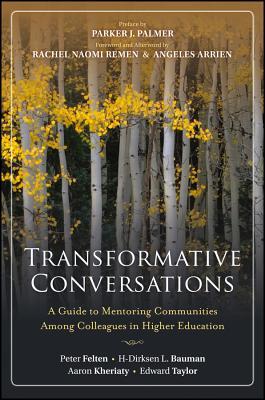
A Review of Transformative Conversations

Image

The world of higher education can often be more de-formative than formative, given the pressures, politics, and financial pressures. The technologizing of higher education raises further questions of relating to large virtual networks of students and colleagues and having very few experiences of real collegiality with flesh and blood colleagues.

The four authors of this book believe they have found a way to change that. Their journey began with a Fetzer Institute program and a mentoring experience with Rachel Naomi Remen and Angeles Arrien who have worked with formational communities in other contexts. They then set out to form “formational mentoring communities” at each of their institutions.

So what is a formational mentoring community? Most basically, it is a safe place for mutual conversation among peers about the important questions of meaning, calling and values and how each other are living these out. For these communities to work, they need to be characterized by hospitality, safety, courage, honesty, trust, diversity, humility, accountability and friendship.

The authors go on to describe the practical questions of how to form the groups–place, frequency, how to invite people, size of the group and so forth. And in a chapter on collaborative stewardship, they go on to describe practicalities of facilitating such groups.

Most compelling to me in this book is the power these authors find in real relationships with four to eight as opposed to the formalized or virtual myriads of relationships. They really did find the conversations transformative as they regained or found a deep sense of meaning and connection with call in their lives. They also found this transforming relationships with students, such as when the faculty in one group at Gallaudet (a college for the hearing impaired) took the coverings off the windows in their offices so that students could SEE when they were in. An important caveat these authors affirm is that these groups cannot be institutionalized but must be informal and voluntary. This cannot become a “program” for humanizing the university, but rather a contagious process.

The authors idealism about the possibility of significant institutional change coming through the proliferation of these groups surprises me. But the narrative of the impact of these groups and the practical resources for beginning such groups will certainly encourage others to attempt such groups whether or not these have widespread impact. The chance to recover a sense of call, meaning and value to ones work would seem to be incentive enough.