Review: Holy Listening: The Art of Spiritual Direction

Holy Listening: The Art of Spiritual Direction
Holy Listening: The Art of Spiritual Direction by Margaret Guenther
My rating: 4 of 5 stars

I’ve read several works on spiritual direction and what I most appreciated about this was the author’s down to earth approach to these matters. She introduces herself as an “amateur” in these things, which carries both the notion of learner and lover. At points I’ve been put off by the professionalization of spiritual direction. Her test of a calling to this is simply that people begin to trust themselves deeply to one.

She begins by describing how she welcomes strangers, those new to a directee relationship. This was very practical, dealing with her own preparation, the preparation of both physical space and a safe atmosphere for direction.

Her next chapter is on the director as a good teacher. Most striking is that good teachers encourage play. While direction often explores serious matters, there can also be a lightness, a joy, and even laughter in this relationship. Good teachers also know the pupil’s limits, are hopeful, ask good questions, evaluate progress, and are themselves learners.

The third chapter explores the idea of director as midwife, the one who comes alongside a birthgiver to instruct and coach, and oft-times to simply wait as insight gestates. Most striking was her discussion of “transition”, a time just before birth where the birthgiver may totally lose a sense of control and how the midwife can give good direction and support at this time to lean into the hard work of giving birth to spiritual insight and growth.

The final chapter explores the direction of women as well as what it means for women to act as directors. Two critical elements here were helping women find their voice and not simply default to submission, and to face the sin of self-contempt, which Guenther especially sees in women. She concludes with an exploration of directing those who have faced abuse.

This is a slim and yet rich book that is probably one of the best treatments of spiritual direction I’ve read, especially valuable for its lack of pretension and refreshing “down to earthness”.
View all my reviews

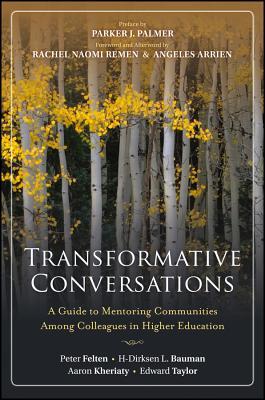
A Review of Transformative Conversations

Image

The world of higher education can often be more de-formative than formative, given the pressures, politics, and financial pressures. The technologizing of higher education raises further questions of relating to large virtual networks of students and colleagues and having very few experiences of real collegiality with flesh and blood colleagues.

The four authors of this book believe they have found a way to change that. Their journey began with a Fetzer Institute program and a mentoring experience with Rachel Naomi Remen and Angeles Arrien who have worked with formational communities in other contexts. They then set out to form “formational mentoring communities” at each of their institutions.

So what is a formational mentoring community? Most basically, it is a safe place for mutual conversation among peers about the important questions of meaning, calling and values and how each other are living these out. For these communities to work, they need to be characterized by hospitality, safety, courage, honesty, trust, diversity, humility, accountability and friendship.

The authors go on to describe the practical questions of how to form the groups–place, frequency, how to invite people, size of the group and so forth. And in a chapter on collaborative stewardship, they go on to describe practicalities of facilitating such groups.

Most compelling to me in this book is the power these authors find in real relationships with four to eight as opposed to the formalized or virtual myriads of relationships. They really did find the conversations transformative as they regained or found a deep sense of meaning and connection with call in their lives. They also found this transforming relationships with students, such as when the faculty in one group at Gallaudet (a college for the hearing impaired) took the coverings off the windows in their offices so that students could SEE when they were in. An important caveat these authors affirm is that these groups cannot be institutionalized but must be informal and voluntary. This cannot become a “program” for humanizing the university, but rather a contagious process.

The authors idealism about the possibility of significant institutional change coming through the proliferation of these groups surprises me. But the narrative of the impact of these groups and the practical resources for beginning such groups will certainly encourage others to attempt such groups whether or not these have widespread impact. The chance to recover a sense of call, meaning and value to ones work would seem to be incentive enough.