Review: Hunger for Righteousness

Cover image for "Hunger for Righteousness" by Phoebe Farag Mikhail

Hunger for Righteousness, Phoebe Faraq Mikhail. Paraclete Press (ISBN: 9781640609341) 2025.

Summary: Drawing upon Coptic and other church tradition, explores how Lent may be personally and communally transforming.

I grew up in a Protestant tradition that did not observe Lent. But I lived in a Catholic neighborhood where the conversation before Ash Wednesday was a discussion of “what are you giving up for Lent?” For most, it was something like candy, or perhaps more narrowly, chocolate. I was never quite clear why God needed people to give up chocolate, or other things during this time. For many of us as adults, that is the extent of our knowledge of Lent. Phoebe Farag Mikhail, who has been shaped by the Coptic Orthodox tradition, fasting, and what one fasted from wasn’t a choice. But what her community abstained from reflected a deeper longing, a corporate hunger for righteousness. She writes of this in her introduction.

If we pay closer attention to the earliest Christian Lenten traditions, we’ll discover how Lent was a period during which individuals who wanted to become Christian prepared themselves not for personal transformation, but to join the body of believers, the communion of saints, through baptism. By examining our liturgical prayers and Scripture readings developed over centuries, we’ll discover the ways Lent has always been a time for individual repentance, yes, but first for giving and forgiving, for mending relationships and building new ones, for fighting injustice, and for growing in intimacy with God communally, not just individually (pp. 13-14).

This book is designed to be read and meditated upon and applied during the weeks before and during Lent. One chapter covers each week, as well as a final chapter on Easter. The first week “trains us for the climb” in preparation for Lent by considering Jonah and the Ninevites through practice of the three day Jonah fast. Subsequent chapters consider:

  • Abraham, reckoned righteous by God, who negotiated with God for Sodom.
  • St. Abraam of Fayoom, a nineteenth century ascetic who gave generously to the poor.
  • The faith that moves mountains, including the mountain of forgiveness.
  • Abba Serapion and the challenge to grow as repentant readers of Scripture.
  • St. Paesia, a trafficked woman, her turning from despair, and the ways we wrongly judge others.
  • The righteousness of Tamar, more determined to perpetuate her husband’s family than Judah.
  • The righteous faith of Abraham again, in the sacrifice of Isaac.

We conclude on the note of Resurrection. Mikhail considers the pilgrimage accounts of Egeria enroute to Jerusalem during Roman times. Egeria walks the way of Jesus passion, and we read of her joy in God and rest in the risen Christ.

Each chapter offers questions for reflection and application. Two appendices offer further resources including the Great Lent Lectionary of the Coptic Orthodox Church of Alexandria.

Mikhail helps us see the fast of Lent as a hunger for righteousness, glimpsed in the lives of biblical figures and saints we may not have heard of before. Whether we adopt the practices of Coptic Christians or not, her reflections help us deepen our own practice of Lent. She helps us move beyond the “give up” to the promise for those who hunger for righteousness. They shall be filled.

_____________

Disclosure of Material Connection: I received a complimentary copy of this book from the publisher for review.

Review: Season of Beauty

Season of Beauty, compiled by Editors at Paraclete Press. Brewster, MA: Paraclete, 2024.

Summary: A collection of scriptures and reflections of great Christian writers along with reproductions of great works of art for Lent, Holy Week, and Eastertide.

While we often think of Lent as the season of fasting, of abstaining culminating in Holy Week and the horror of the cross, there is also beauty in contemplating the way of the Savior, the life to which we are called as followers, and the glory of the resurrection.

Paraclete Press has just published a wonderful collection of readings from scripture, from saints of old and contemporary writers and poets accompanied by an extraordinary number of art reproductions printed on quality paper and a sewn in ribbon bookmark. The readings span Lent, Holy Week, and Eastertide with over half the book devoted to the latter two.

There are a number of Gerard Manley Hopkins (my favorite poet) and Christina Rosetti poems. reflections from The Cloud of Unknowing, Julian of Norwich, Emilie Griffin’s “He Kept On Walking,” Kathleen Norris’s “Hints of Resurrection Abound” and a long version of “Saint Patrick’s Breastplate.”

An example of text and art (publisher’s website)

All of this is accompanied by gorgeous reproductions of art. I appreciated the inclusion of Briton Riviere’s The Temptation in the Wilderness. an El Greco of Mary Magdalene, Ilya Repin’s Last Supper, Thomas Cole’s The Pilgrim of the Cross at the End of His Journey., and Jan Cossiers, Jesus Appears to Mary Magdalene.

I could go on. But the beauty of the design of this book, tastefully laid out with texts and images, is to invite our quiet contemplation, our personal pilgrimage through Lent, Holy Week, and Eastertide (including Hopkins “May Magnificat”).

This indeed is a “treasury” I hope to return to year after year, so rich are the works within.

____________________

Disclosure of Material Connection: I received a complimentary copy of this book from the publisher for review.

Memento Mori

I write these words during a week some predict new infections and deaths from COVID-19 may come to a peak in the United States. It is plain that for many this will be a very bad week. For Christians, this is Holy Week, the final week of Lent. For Jews, Passover in 2020 begins on the night on which I which I write.

“Memento mori.” One of the key aspects of Lent is remembering that we will die. During many years, I suspect this only receives passing attention while we go on with our lives. Not this year. This year has smacked us in the face with death. We have watched death tolls rise in country after country, and now in our own. Suddenly a trip to the grocery store feels like running a perilous gantlet.

“Memento mori.” I’m geeky enough to follow statistics. One of the interesting ones I’ve noticed in our state’s statistics is the median age of those who have died. At present, it is 78. What is striking is that 78.6 years is also the average life expectancy in the US. Now there is some difference between median and mean, but it was close enough that it strikes me that the distribution of deaths approximates that in normal life–some die at every age, but the older you are, the more likely you are to die if you contract this disease. Of course the truth is, the older you are, the more likely you are to die, period. The only thing that is different is that because of this disease, more people at all ages are dying at present. For all of us, this is real!

“Memento mori.” C.S. Lewis reminds us in his sermon Learning in War-Time that war does not increase the frequency of death–“100 percent of us die.” Lewis argues that the one distinctive thing about war is that it forces us to remember death. Young soldiers make out wills. How many of us have made out wills and advance directives in this crisis?

“Memento mori.” The practice of remembering that we will die in Lent is not an exercise in fear or hopelessness. It is an honest reckoning, that along with Christ, we must go through Good Friday before there is Easter. Passover, for the Jews remembers another plague, the death of the firstborn throughout Egypt, sparing the Jews only because of the lamb’s blood on their door posts. Good Friday reminds us of “the Lamb of God who takes away the sins of the world.” Death will take us from this life and this world, but it will not take us from God. As death did not hold Jesus, we believe that death will not hold us. Beyond Good Friday is Easter–Resurrection Day. One day, “he (or she) is risen” will be said of all of us who hope in Christ.

“Memento mori.” I do not think we can truly live with joy in each day without coming to terms with our death. To suppress it, to ignore it, to fear it, to obsess over it robs us of the deeper richness of life’s most ordinary joys. I recognize and respect that not all who read this embrace what I believe. What these times confront all of us with is the real possibility of our death, or that of someone we love. It poses, if we will face it, perhaps the most important question of human existence, which is how we will come to terms with our mortality. Remembering that we will die, and determining how that will shape the way we however many years are yet given us may be the great gift of this pandemic.

Stay safe, my dear friends.

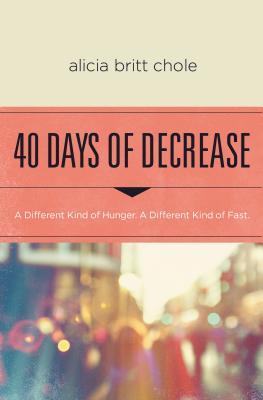
Review: 40 Days of Decrease

40 Days of Decrease

40 Days of Decrease, Alicia Britt Chole. Nashville: Thomas Nelson, 2016.

Summary: A collection of 40 readings, reflections, and different kinds of fasts that encourage us to “thin our lives to thicken our communion with God.”

I wasn’t quite sure what to expect when I first looked at this book. Would this be a collection of cheesy meditations and gimmicky ideas of what one might fast from? Having walked through the book, I would confess myself pleasantly surprised, as well as personally stretched, by the meditations, reflections, and ideas Alicia Britt Chole gives us in these pithy, thousand word entries, designed specifically for the season of Lent, but usable at any time of the year.

Each one of the days is designed as follows: a meditation focused around the journey of Jesus to the cross, a brief reflection, which leads into the fast of the day. These are followed by a more scholarly piece on the history of the Lenten fast, around which this book is organized. There is then a reading for the day taken from a passage in John 12 to 21 (consecutively) and room for one’s own reflections to be jotted down.

In the introduction to the 40 days, Chole writes, “As we experience this sacred season and the holiness of loss and less in Jesus’ journey cross-ward, may our hearts open vulnerably to a greater commitment to love and be loved by the Savior.” The aim of the “decreases” of the different fasts she proposes is an increase in our hunger for communion with God.

While she does include some of the more expected kinds of fasts from food, from speaking, and from sound, she also proposes a number of “fasts” one might not consider but in fact open us up to encountering God in new ways. For example, early on she encourages fasting from regrets for a day, recalling that our gospel hope is that Christ is “making all things new.” Another day, she challenges us to fast from “religious profiling” that underestimates the spiritual potential of certain groups of people. Another day, we are encouraged to fast appearances, and the ways we inflate or deflate, exaggerate or conceal who we are and come to Jesus to help us understand why we do this. I liked one of the later fasts, as one engaged in ministry, which was fasting from “God as job”, which involves “taking care of Jesus’ stuff but not attending to his voice.”

One of the last fasts was one of the most powerful. On Day Thirty Nine, we are encouraged to fast “guarding the tomb” of our past sins, shameful acts, and dead things. She encourages us that in rolling the stone away from such “tombs” that the grave is empty, forgiven by the Risen Lord who “is not here.”

The short pieces at the end, most of which focus on the history of Lent and how this came to be a forty day period related to the preparation of baptismal candidates, are quite informative. Providing a daily reading in John’s passion narrative leaves room for God to speak and meet us in the gospel narrative. All told, what Chole gives us are carefully crafted meditations and reflections, “fasts” that uncover many of the unhelpful attachments that accrete in our lives, and space to decrease that He might increase in our lives.

____________________________

Disclosure of Material Connection: I received this book free from the publisher. I was not required to write a positive review. The opinions I have expressed are my own. I am disclosing this in accordance with the Federal Trade Commission’s 16 CFR, Part 255 : “Guides Concerning the Use of Endorsements and Testimonials in Advertising.”

Review: Walking the Labyrinth

Walking the LabyrinthWalking the LabyrinthTravis Scholl. Downers Grove: InterVarsity Press, 2014

Summary: The book consists of a series of reflections over the forty days of Lent intermingling thoughts on the gospel of Mark, life, and the daily walking of a labyrinth in the churchyard of a neighborhood church.

Travis Scholl discovers a labyrinth in a churchyard in his neighborhood and determines to walk it over the forty days of Lent. Each day, he reflects on a portion of the gospel of Mark, interweaving these reflections with thoughts about life, and the peculiar type of pilgrimage that is walking the labyrinth.

The book begins with a helpful explanation of the history of labyrinths from the myth of Ariadne’s thread to the appropriation of the idea of walking labyrinths as a Christian practice–a kind of pilgrimage both to the center of one’s life and the center of one’s relationship with God.

The use of Mark’s gospel seems especially appropriate. Jesus seems to be perpetually walking in this gospel–a labyrinthine journey around and around Galilee, into the Decapolis and the regions of Tyre and Sidon, and then on to Jerusalem and the cross, which perhaps not coincidentally we learn forms the center of the labyrinth.

Scholl attempts to walk the labyrinth every day, coming at various times in all kinds of weather from snow to the incipient heat of summer. His reflections concern such things as pilgrimage in the middle of things, the seeming labyrinthine and circular natures of life, the westward facing entrance of the labyrinth, symbolizing both death and the hope of the life to come, the cross at the center of the labyrinth and his own life, and much more.

Labyrinths are often inlaid in the floors of cathedrals. "Labyrinth" by Marlith - Own work. Licensed under CC BY-SA 3.0 via Wikimedia Commons.

Labyrinths are often inlaid in the floors of cathedrals.  This is Grace Cathedral in San Francisco. “Labyrinth” by MarlithOwn work. Licensed under CC BY-SA 3.0 via Wikimedia Commons.

One of my favorite reflections was on the labyrinth being like the seed of the kingdom — growing day and night. The seed is itself a kind of labyrinth from which life emerges. Another is on the impossibility of keeping the kingdom secret, as secret as our practices might be. Jesus is in seclusion and sought out by the Syrophonecian women who answers his parable or riddle with a parable. She understands the secret of the kingdom that is found in Jesus, and receives her daughter whole.

Perhaps the final reflections tracing the way of the cross are among the best, as is the very last which captures the incredible excitement of the women’s report, “He is risen. He is going ahead of you into Galilee.” The labyrinthine journey of Jesus begins and ends in Galilee, just as one enters and emerges from the labyrinth in the same place.

The author concludes the book with recommendations and resources for those who want to walk the labyrinth and provides a day by day list of his readings in the gospel of Mark. In some ways, it was better that I read his book at a time other than Lent. While it could be helpful to use these reflections during Lent, there is a part of me that is inspired to find my own labyrinth and journal my own reflections, using Scholl’s book not as a devotional, but as a model. We shall see…

Modest Beginnings of a Lenten Wannabe

Today is Fat Tuesday or Mardi Gras, the day before the beginning of Lent. Can’t say I will be doing any wild celebrations. I will be rehearsing Beethoven’s Ode to Joy  and Bernstein’s Chichester Psalms with Capriccio Columbus and then meeting up with my son for our weekly habit of getting a beverage together and solving the problems of the world (or at least comparing notes on blogging and computers).

I’ve never been part of a church tradition that practices Lent or Advent. What I’m struck with more and more is that without a season of preparation, Easter and Christmas are just these isolated days where we talk about the birth or resurrection of Jesus, and then on we go. A few years ago, I read Bobby Gross’s Living the Christian YearThis book gave me a vision for how the seasons of the year and the traditional church celebrations of the Christian year can remind me of the bigger story in which I live.

The term Lent as best as I can tell comes from the German for long or length and is associated with the coming of spring when the days grow longer. Traditionally it is this 40 day period beginning with Ash Wednesday and ending with Easter. The imposition of ashes is to remind us of our own mortality (“ashes to ashes, dust to dust”), the consequence of human rebellion against God.  It is a season of repentance, of turning back to God expressed in practices of fasting, prayer, and almsgiving. It culminates in Holy Week with Good Friday, when Christ died and Easter Sunday when fasting turns to feasting as we celebrate the victory of Jesus.

This year I want to make modest beginnings in this practice. Since my own community doesn’t impose ashes I probably won’t do this. I’ve decided on a few practices during this season which seem appropriate in my own life:

  • I’ve decided to fast from looking at blogging stats. I think I’ve become a bit too obsessed with this and spend more time than I ought in this practice. Maybe faith, when it comes to blogging is to just write and trust God for views and following.
  • I often spend time looking at stats at the end of the workday. One of the ideas of fasting is to free up time for prayer. So I will take the time I would have spent on stats and pray–perhaps especially for those I’ve interacted with that day.
  • The other is almsgiving. Scripture talks about giving in secret. One of the things I want to do this year is find one way to give or serve in secret each day. It will be interesting to see if I can come up with different ways to do this. At any rate, to keep this practice, I can’t tell you any more about it–at least what I’ve done.

god-for-us-rediscovering-the-meaning-of-lent-and-easter-7

The other practice many observe is some form of Lenten readings. A couple colleagues told me about God for Usedited by Greg Pennoyer. It includes beautiful artwork and readings by people like Lauren Winner, Scott Cairns, Kathleen Norris, and Richard Rohr. We’ve picked up a copy and will use this for Lenten readings.

I really don’t know what to expect. Mostly, I long to live more deeply into the story I believe–to see it move from head to heart and into life–even as I anticipate the celebration of resurrection life on Easter.

I would love to learn from some of you who have gone far deeper in this practice. What are the practices that have meant the most to you in this season? And if you are not a Christian, are there seasons like this in your own faith or worldview and what are the practices that turn that into lived experience?