Review: Protege’: Developing Your Next Generation of Church Leaders

ProtegeIt would be an understatement to say that there is a super-abundance of leadership books in both Christian and general publishing. One wonders if it reflects a perception that there is a dearth of the real thing in our churches and culture, or that if it exists, it is often done very badly. So the question is, what separates Steve Saccone’s book (co-authored with his wife Cheri Saccone) from all the rest?

Very briefly, it is that it is more description, than prescription, of the work Saccone has done in developing leadership through his Protege’ Program, a two year leadership development program. This book is an attempt, without being a program manual, to distill the basic contours of his work.

Saccone begins with the question of what kind of culture leaders are to embody and establish. For him, these are kingdom cultures, cultures that reflect the character of Jesus lived out in churches, organizations, and entrepreneurial efforts.  This leads him to focus on five critical elements in his work:

1. Character. What is most striking here is that Saccone identifies four deadly sins that can bring down emerging leaders: envy expressed in imitating others rather than embracing one’s own unique call, self-reliance that emphasizes performance over a life of prayer producing fruit from the inside out, foolishness expressed in over-confidence rather than the seeking of wisdom, and greed which reveals itself in a spirit of entitlement. It is good that Saccone begins here, I think. I’ve seen few leaders really fail for lack of skill. For most, it comes down to questions of character.

2. Relationships. Here Saccone focuses on three tensions in relational leadership: overcommitment versus underdelivering on commitments, avoiding or evoking conflict, and overattaching versus detaching. There was much that was helpful here concerning learning to say no versus letting your yes be yes. His diagnostics for each of these tensions are very helpful to see where one falls.

3. Communication. This was a section that had some intriguing ideas of learning through everything from TED talks to poetry slams about effective communication in 21st century culture. He describes Learning Labs where he challenges people to give five minute talks (Five Good Minutes) and to practice improvisation.

4. Mission. To start, he sees mission not as something we do but something that flows from our relationship with Christ expressed through the uniqueness of each person in the context of local communities of believers in mission. He calls for several shifts in evangelism: 1) From inattentiveness to attentiveness, 2) From monologue to dialogue, 3) From invasion to invitation, 4) From individual conversion to communal conversion, and 5) From temporal understanding to eternal awakening. These last two call for a bit more explanation. Communal conversion is not whole communities coming to faith but the recognition that the community in which one comes to faith crucially shapes one’s life. Eternal awakenings happen when converts connect their lives to the big eternal questions addressed by the gospel–how the gospel lastingly changes everything.

5. Entrepreneurial leadership. His last section focuses on the quality of risk-taking and developing cultures where there is a freedom to fail, where the ultimate value isn’t control and where they develop new structures to unleash the gifts and creativity of those they lead.

Throughout, Saccone provides numerous examples and personal stories of how he works these ideas out in practice. At the conclusion of each chapter are ideas for mentors, and a mentor tip (not always directly related to the chapter content).

The only thing I might make more explicit in this book is that a crucial work of mentors is to help proteges become protege’ developers themselves.  Young leaders need to be coached to reflect on their own developmental process and to learn from it how they might in turn develop the next generation of proteges.

What Saccone has given us is a kingdom-oriented, character shaped, and missionally driven account of leadership development that offers, not a program, but a vision for the essential elements of any serious effort at protege’ development.

Review: Big Questions, Worthy Dreams: Mentoring Emerging Adults in Their Search for Meaning, Purpose, and Faith

Big Questions, Worthy Dreams: Mentoring Emerging Adults in Their Search for Meaning, Purpose, and Faith
Big Questions, Worthy Dreams: Mentoring Emerging Adults in Their Search for Meaning, Purpose, and Faith by Sharon D. Parks
My rating: 3 of 5 stars

This is one of the books that higher ed professionals have mentioned to me over and over again with regard to the interest in “spirituality” among college students. So, when a friend offered to lend me a copy, I accepted. For me, there were two significant areas of “takeaway” from this book.

The first was Parks exploration of the developmental stage of “emerging adulthood.” I think many of us assume adolescents just move from adolescence to adulthood and we don’t adequately understand this period in between. Even more, we don’t consider how this developmental stage relates to faith development. We often just worry about keeping people in the faith, rather than understand the changes in thinking processes and perception of the world that are occurring and how these must be constructively engaged. Parks proposes that we go through changes in knowing, in forms of dependence, and in forms of community. In knowing, we move from authority based knowing to sometimes unqualified relativism to probing commitments to tested commitments to convictional commitments. In forms of dependence, we move from dependent or counterdependent, to fragile inner dependence to confident inner dependence to interdependence. In forms of community we move from conventional to diffuse to mentoring community to self-selected groups to an openness to the other. A challenge for many religious communities is that they often don’t move beyond the first or adolescent/conventional form in each of these categories. And if our emerging adults do, no wonder we lose them!

The second takeaway was the critical importance of mentoring relationships in this meaning-making process of wrestling with big questions and worthy dreams. Parks explores not only individual mentorship but also how the higher ed process can be a mentoring process and how mentoring occurs in culture and in whole mentoring communities.

Some wouldn’t find this a problem but the book tends to be more descriptive in broad terms than prescriptive in terms of the specifics that higher ed professionals and spiritual mentors can implement in their work. The second is that it seemed to me that the book proposes more of a “designer faith” that individuals craft with the help of supportive mentors rather than a deepening embrace of one of the established religious traditions. While not disparaging of any tradition, the majority of the models in the books are of emerging adults who are “spiritual but not religious”. This is an increasingly popular “option” but one wonders whether this has the power to sustain worthy dreams over a lifetime. At the same time, the book does provide a needed challenge for all religious leaders working with emerging adults: will you minister and mentor in a way that recognizes the developmental process occurring in the lives of these young men and women? That may be the biggest question of all for these leaders.

View all my reviews

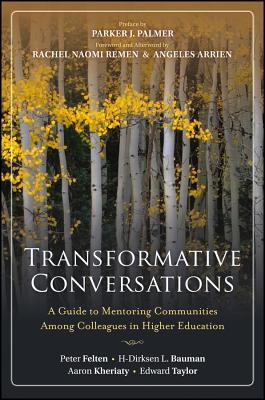
A Review of Transformative Conversations

Image

The world of higher education can often be more de-formative than formative, given the pressures, politics, and financial pressures. The technologizing of higher education raises further questions of relating to large virtual networks of students and colleagues and having very few experiences of real collegiality with flesh and blood colleagues.

The four authors of this book believe they have found a way to change that. Their journey began with a Fetzer Institute program and a mentoring experience with Rachel Naomi Remen and Angeles Arrien who have worked with formational communities in other contexts. They then set out to form “formational mentoring communities” at each of their institutions.

So what is a formational mentoring community? Most basically, it is a safe place for mutual conversation among peers about the important questions of meaning, calling and values and how each other are living these out. For these communities to work, they need to be characterized by hospitality, safety, courage, honesty, trust, diversity, humility, accountability and friendship.

The authors go on to describe the practical questions of how to form the groups–place, frequency, how to invite people, size of the group and so forth. And in a chapter on collaborative stewardship, they go on to describe practicalities of facilitating such groups.

Most compelling to me in this book is the power these authors find in real relationships with four to eight as opposed to the formalized or virtual myriads of relationships. They really did find the conversations transformative as they regained or found a deep sense of meaning and connection with call in their lives. They also found this transforming relationships with students, such as when the faculty in one group at Gallaudet (a college for the hearing impaired) took the coverings off the windows in their offices so that students could SEE when they were in. An important caveat these authors affirm is that these groups cannot be institutionalized but must be informal and voluntary. This cannot become a “program” for humanizing the university, but rather a contagious process.

The authors idealism about the possibility of significant institutional change coming through the proliferation of these groups surprises me. But the narrative of the impact of these groups and the practical resources for beginning such groups will certainly encourage others to attempt such groups whether or not these have widespread impact. The chance to recover a sense of call, meaning and value to ones work would seem to be incentive enough.