April 2014: The Month in Reviews

Another month and another pile of books read! This past month I read of pilgrimages fictional and real, and collections of essays on the future of reading, of politics and religion in the past, and the present relevance of a martyred saint. I read books on big questions, worthy dreams and good and beautiful lives. I explored Winston Churchill’s leadership during World War 2, and a text promoting an alternative to the war around ‘origins’. In case you missed any of the reviews, here is the list with links to my review posts.

1. The Edge of the Precipice: Why Read in the Digital Age ed. Paul Socken. This collection of essays is an exploration of the future of reading and the promotion of reading of great literature by those who love to read and love great literature. It is also thoughtful about the impact of digitization on reading.

2. In Search of Deep Faith by Jim Belcher. Belcher recounts a sabbatical journey with his family through England and Europe exploring the lives, and visiting the sites where those lives were lived out, of his heroes of faith–C. S. Lewis, William Wilberforce, and Dietrich Bonhoeffer among them. His vignettes of these people and his “keeping real” the ups and downs of family life on ‘pilgrimage’ made this a great read.

3. Big Questions, Worthy Dreams by Sharon Daloz Parks. This is an oft referenced work on the spiritual longings of young adults and the role mentors may play in faith and values development.

Untitled-6deep faithbig questions


4. Politics and Religion in Enlightenment Europe, James E Bradley and Dale Van Kley, eds. This collection of papers chronicles the relationship between various religious reform movements and the political structures in their host countries during 18th century Europe–an interesting exploration of the almost unavoidable relationship of religion and politics in another setting.

5. The Good and Beautiful Life by James Bryan Smith. This is the second volume in his Apprentice series and explores how the Sermon on the Mount represents the core of Jesus’ teaching on how one indeed can live a sustainable good life. The book includes “Soul-Training’ exercises and is useful for both individuals and group discussions.

6. The Pilgrim’s Regress by C. S. Lewis. This is Lewis’s first work following his conversion and reflects something of his own spiritual journey. As an early work,  it may not be his best but read it if you love Lewis and you are curious about “why regress?”.

regressbeautiful lifeenlightenment

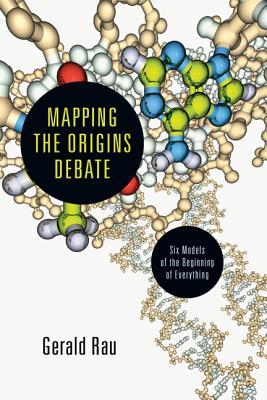
7. Mapping the Origins Debate by Gerald Rau. Rau’s purpose in this work is to delineate the six (not two!) models of origins of the cosmos and life held by different people and how each of these addresses the evidence around the origin of the cosmos, of life, of the species, and of human beings. His does not advocate for a particular view but shows how philosophical presuppositions and one’s definition of “science” shape one’s interpretation of the evidence and which of these models one is most at home with.

8. Winston’s War: Churchill, 1940-1945 by Max Hastings. This is neither strict biography nor war history but a look at Churchill’s leadership as Prime Minister of Great Britain during World War 2. It gives a balanced treatment of Churchill’s indispensable ability to rally his people and woo American support, and the flaws in his relationships with his war commanders and his perception of Britain’s post-war future.

9. Bonhoeffer, Christ, and Culture, Keith L Johnson and Timothy Larsen, eds. This book contains the papers give at the 2012 Wheaton Theology Conference, which focused on Bonhoeffer, and sheds valuable light on his Christ and Word-centered theology, the transforming influence of the Harlem Renaissance in his life, and Bonhoeffer’s decision to participate in resistance against Hitler and how he reconciled this ethically.
mappingwinstonbonhoeffer


That’s the month in reviews. Look for reviews in the next month on a collection of Manhatten Project materials, faith and science in Antebellum America, a new biography of Harriet Beecher Stowe, a landmark work on genocide and American foreign policy and more! Thanks for reading!

Review: Winston’s War: Churchill, 1940-1945

Winston's War: Churchill, 1940-1945
Winston’s War: Churchill, 1940-1945 by Max Hastings
My rating: 4 of 5 stars

“What, another Churchill book?” This was my wife’s comment when she saw me reading this book. I’ve read Churchill’s own account of World War 2 as well as several other biographies. So, beyond my admiration for Churchill, what possible reason was there to pick up this book?

What Hastings does is focus particularly on Churchill’s leadership of England from his ascent to Prime Minister in 1940 during England’s darkest days, to his ignominious departure from office in July of 1945, shortly after Allied victory in Europe. What Hastings gives us is neither a hagiography nor a hatchet job. Rather I found this a balanced treatment that justly celebrates the qualities of character that made Churchill the “indispensable man”, at least up to 1943, as well as delineating the less seemly aspects of his leadership.

Among the latter was his conservatism, which he had to overcome in dealings with Stalin, and resulted in his lack of connection with the domestic concerns of his own people, particularly in post-war life, which accounted for his unceremonious turning out from office. He was also an infuriating dabbler in military strategy, particularly with the British Army, whose leadership frustrated him. He avoided the castastrophic errors such as invading the Dardenelles that brought him down in World War 1 but was often thwarted in diverting forces from the D-Day invasions by the Americans who had to put up with repeated proposals for actions other theaters. He also could not see, as did Roosevelt, the end of Britain’s colonial empire.

All of this, and other flaws, pale in the light of the fact that Churchill was a warrior, more than most of the war-weary military leadership in England. He recognized that Nazi tyranny could never be compromised with, and from early 1940 until America’s entry in the war in late 1941, led Britain in standing alone in the face of possible invasion threats and the air Battle of Britain that convinced Hitler to turn eastward in the fatal decision to invade Russia. Hastings, more than others I’ve read, recognizes that while Churchill and Roosevelt were not nearly as close as often stated, Churchill’s major success was in bringing the US into the European War when it would have been easier to focus our attention in the Pacific. He also argued persuasively for the importance of Allied action in 1943, so that Russia might not be seen as fighting Germany all alone.

One of the things Hastings book explores more thoughtfully than most is this dilemma of allowing Russia to bear the brunt of fighting Germany, arguably a military necessity in light of the weakness of British military forces and the necessary buildup of American forces. Churchill perhaps agonized more than most at the postwar consequences this would have in Eastern Europe, accentuated by his inability to awaken the Americans to these concerns. Consequently, apart from rescuing Greece from communist forces, there was little he could do but protest incursions and broken agreements.

What Hastings book points up for me are the differences between peace time statecraft and warcraft. It seems these may require different kinds of leadership, and that the same person may not always be able to do both. Perhaps that was the distinction between Churchill and Roosevelt. What is clear is that when war comes, nations need leaders who can lead with courage and resolution to “see the thing through” and can impart that courage to their people, something Chamberlain could not do and both Churchill and Roosevelt did.

View all my reviews

Why I Am Praying for Putin–and Obama

I am a history buff. I’ve read a fair degree of European history and military history–probably just enough to be dangerous! As I’ve followed the events in the Ukraine these past weeks, it has dawned on me that this is something not to be taken lightly. The Crimea is not simply some place far off in Eastern Europe. It represents a number of places in Eastern Europe that were both once part of the Soviet empire and that have Russian populations. And what is trickier is that many of these countries, including Ukraine now are engaged in NATO alliances, which at least theoretically involve obligations to intervene militarily if they are attacked. And of course, the US continues to have significant NATO obligations.

Vladimir Putin Attribution: Kremlin.ru

Vladimir Putin
Attribution: Kremlin.ru

I suspect there are some who are better historians who can tell me how this is different from the conditions that led to the folly of World War 1, when a flashpoint assassination activated a series of military alliances that led to a full scale European war that drained the life blood of a generation. Then, as now, everyone seemed to think that in the end, diplomacy would save the day, until it was overwhelmed by the momentum of events.

Barack Obama Attribution: By Pete Souza, The Obama-Biden Transition Project [CC-BY-3.0 (http://creativecommons.org/licenses/by/3.0)], via Wikimedia Commons

Barack Obama
Attribution: By Pete Souza, The Obama-Biden Transition Project [CC-BY-3.0 (http://creativecommons.org/licenses/by/3.0)], via Wikimedia Commons

I’m also troubled by the reality of a great nation, Russia, humbled by the crumbling of the former Soviet Union, stripped of what they perceived as their western buffer, devastated economically, now experience something of a resurgence of its power, at least regionally under a strong leader. While the formal humiliation was not, perhaps, as severe as that of Versailles, it occurs to me that the same similar dynamics could be at work in this situation.

It is almost 70 years since the end of World War 2 and many of us grew up thinking that another European conflict, particularly under the threat of nuclear weapons, was unthinkable. Sadly, the story of what Barbara Tuchman once called “The March of Folly” is that people and societies will do the unthinkable and irrational–all very rationally to appearances.

And so I found myself praying today for both Vladimir Putin and Barack Obama, and the decisions each will make in the days ahead. They could make the difference between peril and peace, and it seems that wisdom from on high wouldn’t hurt.

[BTW, I welcome comments but I won’t approve/host those which are simply partisan rants!]