The Weekly Wrap: November 23-29

parcels in beige wrapping paper and christmas decorative lights
Photo by Nur Yilmaz on Pexels.com

The Weekly Wrap: November 23-29

Thanksgiving Reflections of a Bibliophile

We celebrated Thanksgiving in the United States on Thursday. It is often the custom to share for what we are thankful, often at the overladen dinner table! But if I were to share for what I’m thankful for as a bibliophile, no one would get in a word edgewise! So, here’s my chance.

First of all, there are the books themselves! They entertain, capture the imagination, inform, and inspire. They enlarge my world and make it more interesting.

Then there are those who sell them! Almost to the person, booksellers are people who share my booklove and love to serve others by connecting them with books they’ll love. I most admire those who own bookstore–always a challenging financial proposition and a labor of love. I don’t know any rich booksellers.

It’s been a privilege to connect with a number of authors. No matter what I think of their books, I am aware of the arduous work of writing and rewriting and the courage to believe others will be interested in what they’ve written. I’m thankful for the disciplined passion that gives birth to their books.

Then there are the publishers. I’m especially grateful for the small publishers who take the risks to bring new authors to our attention. I think of all the people in publishing houses whose work makes this possible: editors, publicists, graphic designers, marketers, and the administrative people who support the enterprise.

A group I increasingly admire are librarians. They do so much more for their communities than help us borrow the books we want or learn about those we might like. They serve a variety of community needs from job searches to dealing with drug overdoses. Increasingly, they are the front line troops ensuring that the books we want, no matter how controversial for some, are available to read.

Finally, as a “book influencer,” I have the chance to interact with many other booklovers and my life is so rich for it. I’m constantly learning from their insights and book recommendations. And its a joy when I learn a review has helped someone find a book they love. Summing it all up, there is so much for which I’m grateful–and I’ve spared you!

But if only my beloved Buckeyes can break their losing streak today and defeat That Team Up North! Then all will be right in my corner of the world!

Five Articles Worth Reading

Bibliomania, the only hobby which is also a mental health affliction. The person with piles of titles on their nightstand, in their closet, in the trunk of their car. Books in front of books on their bookshelf.” Ed Simon explores why this is true of so many of us as bibliophiles in “Nothing Better Than a Whole Lot of Books: In Praise of Bibliomania.”

But what happens to all those books when we die? Kelly Scott Franklin especially explores the fate of all the e-books on our readers as he deals with his mother’s passing. Along the way, he asks profounder questions about our lives, libraries, and literary productions in “The Bad News.”

Meanwhile, literary studies are facing steep cuts in many of our universities. Against that backdrop, Johanna Winant celebrates her experience teaching of close reading through her classroom interactions with appreciative students. She raises important question of what we are in danger of losing in “The Claims of Close Reading.”

The name Czesław Miłosz keeps coming up for me–a signal that I ought to explore his work. This article, “A Quarrel with the World,” piques my interest as it explores his underground work and internment in World War Two and how Communists tried to claim him as one of theirs, necessitating his flight from Poland to France.

Finally, in early November, Marilynne Robinson received the Lewis H. Lapham award from Harpers Magazine. In her brief remarks, she incisively puts the case for the necessary work of maintaining our democracy. You can read her remarks in “‘The Voice of a Free People is Full of Turbulence and Grace.’ Marilynne Robinson Accepts the Lewis H. Lapham Award.

Quote of the Week

Poet and hymnwriter William Cowper (pronounced as we would pronounce “Cooper”), was born on November 26, 1731. I will leave you with this aphorism, a rhyming couplet:

“They whom truth and wisdom lead, can gather honey from a weed.”

Miscellaneous Musings

I finished one of the more profound books this week that I’ve read in some time. Esther Lightcap Meek’s Loving to Know explores what she calls “covenant epistemology” which she frames as a radical alternative to both Cartesian and post-modern epistemologies. She draws heavily on the work of Michael Polanyi to propose a way of leaning that is neither merely objective nor subjective but personal.

I also finished Rick Atkinson’s Fate of the Day, the second in his planned trilogy of Revolutionary War books. What most impressed me was that to a significant extent the colonists, and especially Washington, won by avoiding outright defeat, until France could help administer the final coup de grace.

Finally, I am returning to a writer whose work I’ve loved, Tish Harrison Warren. An Anglican priest and former New York Times op-ed writer, she wrote a book a couple years ago, Advent, that a book group I’m a part of is reading. I like her idea of “making Christmas weird, again.”

Next Week’s Reviews

Monday: The Month in Reviews: November 2025

Tuesday: Tish Harrison Warren, Advent

Wednesday: Mark R. Glanville, Preaching in a New Key

Thursday: Mark Tabb, Am I a Better Christian on Zoloft?

Friday: David McCullough, Brave Companions

So, that’s The Weekly Wrap for November 23-29.

Find past editions of The Weekly Wrap under The Weekly Wrap heading on this page

The Weekly Wrap: May 11-17

woman in white crew neck t shirt in a bookstore wrapping books
Photo by cottonbro studio on Pexels.com

The Weekly Wrap: May 11-17

Story Keeping

We have always loved storytellers, from the stories told in oral cultures, to writers who spin stories, to historians who research and tell the stories of our past. Less glamorous, but just as important, I would contend, are those who are story keepers. Without story keepers, our stories may die within a generation or less, whether from neglect or deliberate action.

Who are the story keepers? They are the publishers who keep important stories in print. They are the librarians who keep the stories on their shelves and connect readers and books. Booksellers, who take financial risks to make books available to readers are story keeping heroes.

I believe we are entering a season where story keeping is taking on greater importance. For example, books are being removed from libraries in service academies and schools. Others have pressed for the removals of books from public libraries. It may be subjects labeled “DEI,” which may include many works of Black, or other ethnic histories. Or it may include books portraying non-traditional gender identity or sexual orientation. If it has been politicized, it has probably been challenged or removed.

I don’t necessarily agree with all the stories or how they ought to be told. It is messy because of the rich mosaic of people who make up our society. Some just think it is simpler to erase the stories that differ from our favorite rendering of the story. But when we do this, we only hear the versions of a story from those who hold power. Then dissenting stories that give a fuller perspective are silenced. Simpler but smaller is what we get.

We are all important to the work of story keeping. We can support publishers, librarians, and booksellers. Whenever we buy and read and talk about books, we are story keepers. And when we read diverse books, we help keep alive the stories of those on the margins whose stories are under attack. We should aggressively resist any effort to ban or destroy books. I hope we don’t come to the day of Fahrenheit 451, where it becomes the task of those who want to save the stories to memorize them. Ultimately, they understood that this is what it meant to save civilization.

Five Articles Worth Reading

Summer is coming and the reading is easy. The Atlantic The Summer Reading Guide” offers recommendations of great books for the beach or those hot summer afternoons where we dive into a book while sipping our sweet tea.

Were there books that made you challenge the conventions, that opened your mind to new ways of thinking about life, relationships, society? Timothy Aubry explores this topic in “Gateway Books.” What were your gateway books?

Then, perhaps you would study philosophy to explore the meaning of life. However, Pranay Sanklecha describes how this is not what he found in his philosophy studies in “Philosophy was once alive.”

What is “close reading”? In a review of On Close Reading by John Guillory, Dan Sinykin explores how one defines “close reading” and its place in literary studies. The article is “Pay Attention!” His own argument for close reading in the penultimate paragraph made reading this one worth it for me.

Finally, Mrs. Dalloway is one hundred years old! “A Hundred Years of Mrs. Dalloway” explores how Virginia Woolf’s novel was so revolutionary both in its day and in its long-term impact.

Quote of the Week

Feminist poet Adrienne Rich was born on May 16, 1929. She observed:

“Lying is done with words and also with silence.”

It seems to me that this is a corollary to Edmund Burke’s famous statement, “The only thing necessary for the triumph of evil is for good men to do nothing.”

Miscellaneous Musings

Ron Chernow’s Mark Twain arrived at my doorstep today. It is another massive biography, coming in at over a thousand pages of text. I’ll literally be reading that all summer. But if it is like his previous works, it should be a great ride.

I was surprised how much I enjoyed Tomorrow, and Tomorrow, and Tomorrow by Gabrielle Zevin. If anything, I have enjoyed The Storied Life of A.J. Fikry even more. And its main character is a somewhat cranky bookseller!

As an addendum to my thoughts on story keeping. I consider reviewing as a form of story keeping. I try to review a variety of diverse and important books and it is one of my ways to be a story keeper, making sure others know of these important stories.

Next Week’s Reviews

Monday: Wesley Vander Lugt, ed. A Prophet in Darkness

Tuesday: Agatha Christie, Third Girl

Wednesday: Jeffrey W. Barbeau, The Last Romantic

Thursday: Ezra Klein, Derek Thompson, Abundance

Friday: Michael J. Gilmour, Reading the Margins

So, that’s The Weekly Wrap for May 11-17, 2025!

Find past editions of The Weekly Wrap under The Weekly Wrap heading on this page
Close Reading in a Browsing Age

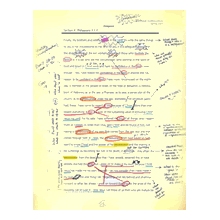
This post comes out of a recent conversation with a student leader of one of our “manuscript Bible studies”. This form of study is called “manuscript” because we make copies of the text of a passage in the Bible (in one of the modern English translations) without verses or paragraphs. Participants are given markers and invited to carefully observe the written text, marking up the things they see, the connections between different parts of the text, and the questions they have. We encourage people to look for the “meaning markers” good writers use to convey meaning–repetition, contrast, various ways that ideas are related such as cause and effect or particulars to general truths. We look for figures of speech, we look up places and unfamiliar words. As far as this is possible, we do this to try to understand the text as its first readers would, and only then try to make application to our lives in our cultural context of the key ideas in the text.

A rather weathered manuscript

A rather weathered manuscript

English lit students would describe this as a form of “close reading”. Looking carefully at words, sentences, the relation and flow of ideas, the narrative or discursive arc matter. And what this student leader and I noted was how unusual this kind of reading is, even in the graduate school context. In truth, it is not possible for graduate students to practice “close reading” with most of the material they look at. There simply isn’t time.

But it also occurs to me that this is reflected in our wider culture as we’ve moved from print to digital–from a physical page to electronic print. I find myself increasingly accustomed to quickly scanning most of what I see on a screen, except maybe when I’m reading a book on my e-reader. I do this with email, websites, articles, and, truth be told, other blogs. What is also troubling is that I catch myself doing this even when I want to give more focused attention to a piece of writing, whether it is an important email from a work colleague, or a work of literature worth savoring. Worst of all as a person of faith, I find myself reading my scriptures this way.

Like the grad students I work with, I slip into this strategy to survive–I can’t possibly “close read” all the things that come across my screen. And for some of these things–simply a general awareness is enough. But I also wonder if I’m developing habits of reading  that reads a mile wide and an inch deep, and becomes impatient with slowing down to read a sentence or paragraph.

One of the things I wonder is whether I’m glutting myself with too much stuff on the screen. I also wonder if it makes me less apt to discern and pay attention to messages that really matter–whether in an email, or an important work of literature or my Bible. Am I less inclined to read closely, listen closely, and understand when it matters? Might I do better to get back to that printed text (whether it is Shakespeare, Doestoevsky, or the Bible) , marker in hand, leaving off browsing posts and sites I’ll soon forget?

Is this just my quirkiness? Are others wrestling with this tension between browsing and close reading? How do you do it?

Reading as Art?

I’ve sung from the time I was a kid. Most of us do, even if only in the shower or in the car when our favorite song comes on. In Buckeye town, we sing “Carmen Ohio” and “Hang on Sloopy” at games. Likewise, I’ve read since I was young. As I thought further about my post on “Reading Musically” it caused me to wonder if reading can be on one level something most of us do, even if it is only ads and road signs, and on another level, something we do artfully?

What are some marks of artful reading? Here are a few starting thoughts:

1. As I’ve remarked elsewhere, it is attentive reading–reading where we give our full attention to the page. When I am engaged in choral singing, I have no bandwidth for anything else than the work–and maybe not even enough sometimes!

2. Artful reading grows in our capacity to observe the writer’s art in all its varieties of use of language, argument and rhetoric, plot development, etc.

3. Good reading grows in awareness of the conversations and conventions that make up a work. Just as there are particular rhythms and thematic elements in various forms of music, the more we read, the more we recognize how writers interact with each other.

4. Reading as an art creates something out of what is read. If nothing else, it creates richer mental furniture in our lives. Perhaps it inspires or even changes our thinking and behavior. For me, the experience of singing Brahm’s Requiem was transformative, particularly Brahms’ passages about the resurrection. Likewise, books like Alan Paton’s Cry, the Beloved Country have been part of a journey for me in learning to love my own land and to pursue healing in our own troubled racial history.

5. Artful reading, like other forms of art shares its fruit, in book discussions, in reviews, in passing along a good book to a friend. When I have rehearsed a piece that I love, I want people to come hear us.

Just a few thoughts on this.  I wonder what you think. Are these just the crazy reflections of a bibliophile? Or is there something to this, perhaps even something in danger of becoming a lost art?