Review: The Digital Public Square

The Digital Public Square, Jason Thacker, editor. Brentwood, TN: B & H Academic, 2022.

Summary: A collection of essays exploring the contours and complexities of the digital public square, specific issues that have arisen, and the call of disciples as they engage the digital public square.

Nearly forty years ago, in The Naked Public Square, the late Richard John Neuhaus argued that we cannot strip the public square of belief, religious or otherwise. He argued for a public square practicing principled pluralism, where Christian belief, as well as others, had a place in public discussions. Today, much of our public square discussions occur on various online platforms in the digital world. For Christians who seek to carry forward Neuhaus’ project in this world, it is necessary to understand the nature of the digital public square and the issues that will confront one to frame a Christian engagement that is both faithful to Christ and cogent. That is the purpose of this volume of essays edited by Jason Thacker, the chair of research in technology ethics for the Ethics and Religious Liberties Commission of the Southern Baptist Convention.

The collection is organized into three parts. The first part, “Foundations” surveys the landscape of the digital public square. Thacker introduces the section with an essay, “Simply a Tool?” that explores the value-laden of our technology that must be critically appraised and not simply accepted. Bryan Baise looks at how our technology has changed the shape of our public square. Nathan Leamer and Patricia Shaw offer American and global perspectives respectively on governmental approaches to telecom law, AI, and privacy issue. David French concludes the section in his usual, carefully reasoned fashion, discussing the legal and policy issues of online governance and how difficult it is to ask the government to intervene in content moderation. In the end, he believes much of it comes down to personal responsibility rather than looking for government to save us from ourselves.

Part Two focus on “Issues.” Joshua B. Wester discusses religious liberty and freedom of speech essays in the digital context where individuals or groups can be “de-platformed” for expressing viewpoints that fall outside the character of publicly accepted ideas. As private entities platforms from Amazon to Twitter can do this with no avenue of recourse in many instances. In the case of Amazon and books, this can result in a significant revenue loss and essentially mute an author’s voice. Brooke Medina discusses the difficulties in the terminology of “hate speech” and in the policing of such speech online. Classic criteria allowed most speech other than that which actively incited or was likely to incite violence. Sometimes, online technologies such as YouTube have actively been used for such ends in other countries with tragic results. How then will Christians resist and report such speech while engaging in reconciliatory speech?

Jeremy Tedesco and Christiana Kiefer discuss content moderation policies, particularly as they have sometimes been applied to Christians affirming traditional sexual ethics and the experience of censorship in online discussions (I found it interesting that they did not discuss similar efforts of Christians in the realm of book challenges and bans). Bonnie Kristian discusses online pornography, the case for banning it and the difficulties, particularly the deleterious effects of having humans moderate content on their personal lives and emotional stability. We don’t like the idea of “bots” doing this but have we thought of how this effects humans. Much like David French, she argues for personal responsibility and virtue.

Jason Thacker contributes another quite fine essay on conspiracy theories and the “post truth” digital world. He returns to the idea of principled pluralism, the belief in and advocacy for truth, recognizing that others may see things differently but that this does not warrant a contempt for or the trivializing of truth. Olivia Enos explores the world of the “heavy handed” regimes that use digital technology to surveil citizens on one hand and to suppress access to information on the other. She particularly exposes the uses of digital technology of the Chinese in repressing their Uyghur minority and similar actions in Belarus. What is also disturbing is to read about how such regimes export this technology to others and, in contrast to American commitments to the free flow of information, seek to exercise cybersovereignty over their information.

Part Three considers the Church’s discipleship and witness in light of the digital public square. Jacob Shatzer considers the opportunities for and challenges to discipleship. While noting opportunities for digital community and digital education, he notes a number of problems: loneliness and paradoxically, never alone, being reduced to our data, enticements to idolatry, distraction, poor abilities to relate, and lacks of accountability. Shatzer does not seem to offer much in the way of remedy other than the call to follow Jesus is still binding and calls us to press through these things. Keith Plummer focuses on our witness before a watching world. He draws on the work of Francis Schaeffer, contending we must embrace two orthodoxies–one of doctrine and the other of loving communities. The truth is evident in the beauty of our relationships, leading Plummer to argue for the importance of the local and embodied presence amid the opportunity of virtual worlds.

Thacker, in an afterword acknowledges the challenge of such a book with the rapids changes of technology and illustrates it with noting the likelihood that Elon Musk wouldn’t acquire Twitter after all. There was a time when this looked to be so but that acquisition has in fact changed the landscape of platform moderation for all the social media companies. The book also preceded the rise of ChatGPT, and the implications for our digital public square of increasing amounts of AI generated content and product. My own sense is that we may not be able to see very far down the road but this book does help ask the question of how we will engage the digital public square, particularly recognizing the value-laden character of our technologies and platforms.

After the turmoil of the Trump presidency and the pandemic years, my sense is that we are taking a collective breather. With the approach of the 2024 elections, this is coming to an end. Now is the time for careful thought about how, as Christians, we will cogently and faithfully engage the digital public square in ways that uphold Christ and seek the common good. These essays offer a great place to begin.

________________________________

Disclosure of Material Connection: I received a complimentary review copy of this book from the publisher.

Review: Restless Devices

Restless Devices, Felicia Wu Song. Downers Grove: IVP Academic, 2021.

Summary: An exploration of how our digital devices shape us, our relationships, and our economic life, and how we might establish a “counter” lifestyle shaped by our communion with God and each other.

Do you recall how your life changed when you acquired your first smartphone? Or think further back to your first cell phone, or the advent of the World Wide Web? Some of us remember the advent of email. Each of these changed how we work, how we relate with others, our economic activity, and the use of our time.

Felicia Wu Song began to notice an uneasy feeling in her life in relation to digital devices, from seeing them as serving her to beginning to recognize that she was serving them. She was reminded of an observation by Jurgen Habermas “that the ruling logic of the economy had hopped the boundaries of the market and begun to exert control over historically noneconomic aspects of life such as family and community.” She notes the rise of dissenters from the very ranks of those who created the architecture of Google, Facebook, and Twitter, decrying the consequences of the technology they helped create.

The first part of the book explores how our broader social and cultural structures make our digital ecology so compelling. It is not just a lack of willpower. We are digitally tethered 24/7 making us constantly available, and even if we have powered off our devices, our minds are still there, wondering what we are missing out on. It turns out that the tech companies actually reward our continuous use and become the medium of our relationships and the means of “performing” our identities.

The second part of the book explores how we counter this. The counter begins with a counter-narrative rooted in the Christian story of being made for communion with God and each other as embodied creatures. In the long history of the church are counter-practices and counter-liturgies. Drawing on James K. A. Smith’s ideas of liturgies as thick, formative practices–whether on Facebook or in church, she both identifies the secular digital liturgies and propose counter-liturgies. Whereas our digital technologies enable us to “push our productivity to the max,” practices of spiritual formation invite us to shift from managing our time to managing our attention, inviting us into adoration, and being open to holy interruptions.

I appreciated her discussion of faithful presence. This often sounds mild-mannered or passive until we consider what God’s faithful presence with Israel was like or that of Jesus during his ministry. Wu Song invites us into the powerful work of embodied, rather than digitally disembodied, presence with others. She believes the church can be a powerful counter-culture with counter-liturgies that help liberate us from the tyranny of our devices. The practice of Sabbath is one such counter-practice. She is not a Luddite. She recognizes both the usefulness and pervasive presence of the digital in modern life. Rather, she calls us to an ordered digital life and even proposes ten commitments to help us do so. Here’s one: “When I am sad, bored, angry, lonely, or anxious, reach for another person, nature, or God before turning to a screen.”

This brings me to one other aspect of the book, four “experiments in praxis.” The first is taking a 24 hour digital media fast–what to fast from, exceptions, preparing and debriefing. The second is digital stock-taking, in which we monitor and become more self-aware of our digital usage and how this makes us feel and even change our posture. The third has to do with counter-liturgies: creating a sacred zone around our beds, monotasking, boundaries in which we set blocks or limits on app usage, and finally new bedtime and morning routines. Each of these run three to five days. Finally, the last is to determine alternate paths and new futures based on the readings and praxis exercises.

At the beginning of the book, Felicia Wu Song mentions C. Wright Mills observation that personal troubles are often public issues. What she has done in this book are a few helpful things. One is to name the public issues, how the hard and software we carry around have been designed to addict us to their use and shape our lives. Another is to help us stop and pay attention to this aspect of our lives through the praxis exercises. Finally, she lays the groundwork for a Christian counter-culture, critically aware of the uses and abuses of this technology, and intentional about refusing to allow our devices to distract us from communion with God and each other, and the rich embodied practices of Christians at work, play, and worship throughout the church’s history.

This book is a good first step toward breaking the technopoly over our lives. It doesn’t solve the public issues but helps us become reflective on how we are being shaped and how we regain a sense of our own embodied personhood, communion with others and faithful physical presence in the world. This is a good beginning.

____________________________

Disclosure of Material Connection: I received a complimentary review copy of this book from the publisher in exchange for an honest review. The opinions I have expressed are my own.

Close Reading in a Browsing Age

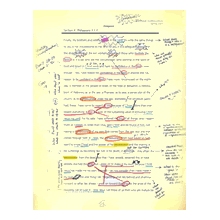
This post comes out of a recent conversation with a student leader of one of our “manuscript Bible studies”. This form of study is called “manuscript” because we make copies of the text of a passage in the Bible (in one of the modern English translations) without verses or paragraphs. Participants are given markers and invited to carefully observe the written text, marking up the things they see, the connections between different parts of the text, and the questions they have. We encourage people to look for the “meaning markers” good writers use to convey meaning–repetition, contrast, various ways that ideas are related such as cause and effect or particulars to general truths. We look for figures of speech, we look up places and unfamiliar words. As far as this is possible, we do this to try to understand the text as its first readers would, and only then try to make application to our lives in our cultural context of the key ideas in the text.

A rather weathered manuscript

A rather weathered manuscript

English lit students would describe this as a form of “close reading”. Looking carefully at words, sentences, the relation and flow of ideas, the narrative or discursive arc matter. And what this student leader and I noted was how unusual this kind of reading is, even in the graduate school context. In truth, it is not possible for graduate students to practice “close reading” with most of the material they look at. There simply isn’t time.

But it also occurs to me that this is reflected in our wider culture as we’ve moved from print to digital–from a physical page to electronic print. I find myself increasingly accustomed to quickly scanning most of what I see on a screen, except maybe when I’m reading a book on my e-reader. I do this with email, websites, articles, and, truth be told, other blogs. What is also troubling is that I catch myself doing this even when I want to give more focused attention to a piece of writing, whether it is an important email from a work colleague, or a work of literature worth savoring. Worst of all as a person of faith, I find myself reading my scriptures this way.

Like the grad students I work with, I slip into this strategy to survive–I can’t possibly “close read” all the things that come across my screen. And for some of these things–simply a general awareness is enough. But I also wonder if I’m developing habits of reading  that reads a mile wide and an inch deep, and becomes impatient with slowing down to read a sentence or paragraph.

One of the things I wonder is whether I’m glutting myself with too much stuff on the screen. I also wonder if it makes me less apt to discern and pay attention to messages that really matter–whether in an email, or an important work of literature or my Bible. Am I less inclined to read closely, listen closely, and understand when it matters? Might I do better to get back to that printed text (whether it is Shakespeare, Doestoevsky, or the Bible) , marker in hand, leaving off browsing posts and sites I’ll soon forget?

Is this just my quirkiness? Are others wrestling with this tension between browsing and close reading? How do you do it?